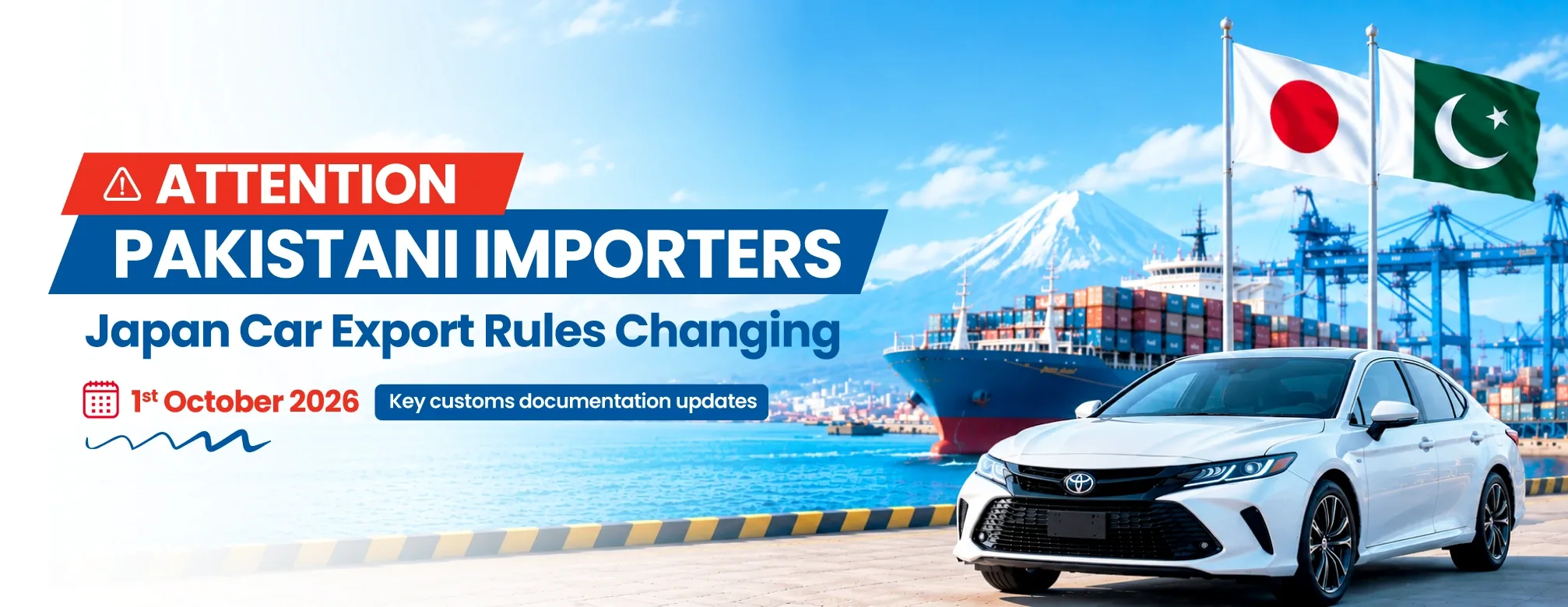
New Japan Car Export Rules Now in Force: Pakistani Importers May Need to Provide Import Documents.
From 1 October 2026, Japanese exporters must keep proof of import in certain payment cases.
 Buying Guide
Japan Car Export Rules Change on 1 October 2026: What Pakistani Importers Must Know
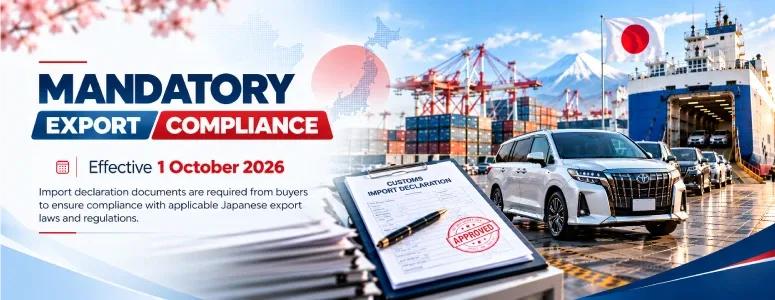
If you import used cars from Japan, 1 October 2026 is an important date to keep in mind. From this date, Japanese exporters may be required to obtain and retain official documentation confirming that exported vehicles have been properly imported into the destination country in certain applicable transactions.
For Pakistani importers, this means that when your exporter requests import or customs documentation, you may need to provide clear and valid records after the vehicle arrives in Pakistan.
What Is Changing?
In certain payment situations, Japanese exporters may need to obtain and retain official evidence confirming that the exported vehicle was imported into the destination country.
This documentation is required for Japanese tax and export compliance purposes.
For importers, the practical point is simple: if your exporter requests the required import documentation, provide it accurately and within the requested timeframe.
Who Does This Apply To?
The requirement applies to Japanese exporters and the importers or consignees involved in applicable transactions. It does not necessarily apply to every export transaction or every payment method.
The requirement may apply particularly where payment is made in cash or where the payer cannot be clearly identified as the buyer. Certain bank transfers and bills of exchange may be treated differently.
If you are unsure whether the requirement applies to your transaction, confirm the applicable documentation requirements with your exporter before making payment.
Which Documents May Be Required?
Depending on the transaction and destination country, the exporter may request documents such as:
- Import permit
- Customs import declaration
- Customs clearance certificate
- Goods declaration
- Other official evidence confirming importation
Documents should be clear, complete and authentic. Electronic copies or records of genuine documents may be accepted where permitted and requested by the exporter.
How Does the Process Work?
- Order and Payment
- You place your order and make payment according to the agreed invoice and payment terms.
- Export From Japan
- The vehicle is prepared and exported from Japan with the required shipping and commercial documents.
- Shipment
- The vehicle is shipped to Pakistan along with the relevant shipping documentation, such as the Bill of Lading and invoice.
- Import and Customs Clearance in Pakistan
- Once the vehicle arrives, you complete the required import and customs clearance procedures and receive the relevant official documents.
- Provide the Documents to Your Exporter
- If requested, provide clear and authentic copies or electronic records of the required import and customs documents.
- Exporter Retains the Records
- The exporter keeps the documentation for applicable Japanese tax and compliance purposes.
The important point: Do not assume that your responsibility ends when the vehicle is delivered. Keep your import and customs documents safely and provide them if your exporter requests them.
What Happens If the Required Documents Are Not Provided?
If the required documentation is not provided, the exporter may face Japanese consumption tax obligations and, depending on the circumstances, applicable penalties, interest or other costs.
Under the applicable invoice and contractual terms, the importer may also be responsible for certain costs or consequences resulting from failure to provide required documentation.
For this reason, keeping your import records complete and responding promptly to documentation requests is important.
Why Is Compliance Important?
Providing the required documentation on time can help maintain a smooth export and business relationship with your Japanese supplier.
It can help with:
- Proper completion of export documentation
- Japanese tax and compliance requirements
- Smoother processing of future transactions
- Maintaining clear business records
- Supporting a reliable long-term relationship with your exporter
The Documentation Requirement May Continue After Delivery
Importers should keep their import and customs documents even after payment, shipment, customs clearance and vehicle delivery have been completed.
If your exporter requests documentation at a later stage, you may still need to provide the relevant records where required under the applicable transaction terms and Japanese law.
Any contractual dispute or legal matter will be subject to the applicable terms agreed between the parties and relevant Japanese law.
Our Advice to Pakistani Importers
To make the process easier:
- Review your exporter's invoice and payment terms before making payment.
- Ask which import documents may be required for your specific transaction.
- Keep copies of all customs and import documents after clearance.
- Make sure the documents are clear, complete and authentic.
- Provide requested documents to your exporter within the required timeframe.
- Keep your records safely for future reference.
Frequently Asked Questions
When do the new requirements start?
The requirements apply to applicable export transactions on or after 1 October 2026.
Does this apply to every vehicle imported from Japan?
Not necessarily. The requirements depend on the applicable transaction and payment circumstances. Confirm the requirements with your exporter for your specific order.
Which documents may I need to provide?
Depending on the transaction, examples may include an import permit, customs import declaration, customs clearance certificate, goods declaration or other official evidence confirming importation.
What happens if I do not provide the required documents?
The exporter may face applicable Japanese consumption tax obligations, penalties, interest or other costs. Your contractual terms may also make you responsible for certain consequences.
Do I need to keep the documents after the vehicle is delivered?
Yes. It is recommended that you keep your import and customs documentation safely after clearance and delivery in case the exporter requires it for compliance or record-keeping purposes.
Buy With Confidence From MDK Japan
MDK Japan has been involved in the Japanese automotive trade since 2006, helping automotive businesses and buyers source vehicles from Japan with professional support and reliable export coordination.
If you have questions about the documentation requirements or your next vehicle order, speak with the MDK Japan team before completing your transaction.
Visit: www.mdkjapan.com
UAN: 111-222-635

No comments yet. Be the first to comment!